The branch that crawls every afternoon.
We trace the traffic, isolate the constraint, and fix the actual bottleneck—not the loudest symptom.
An AI cluster. A new office. A security overhaul. Whatever is next, we design it with your team—and stay for the hard parts.
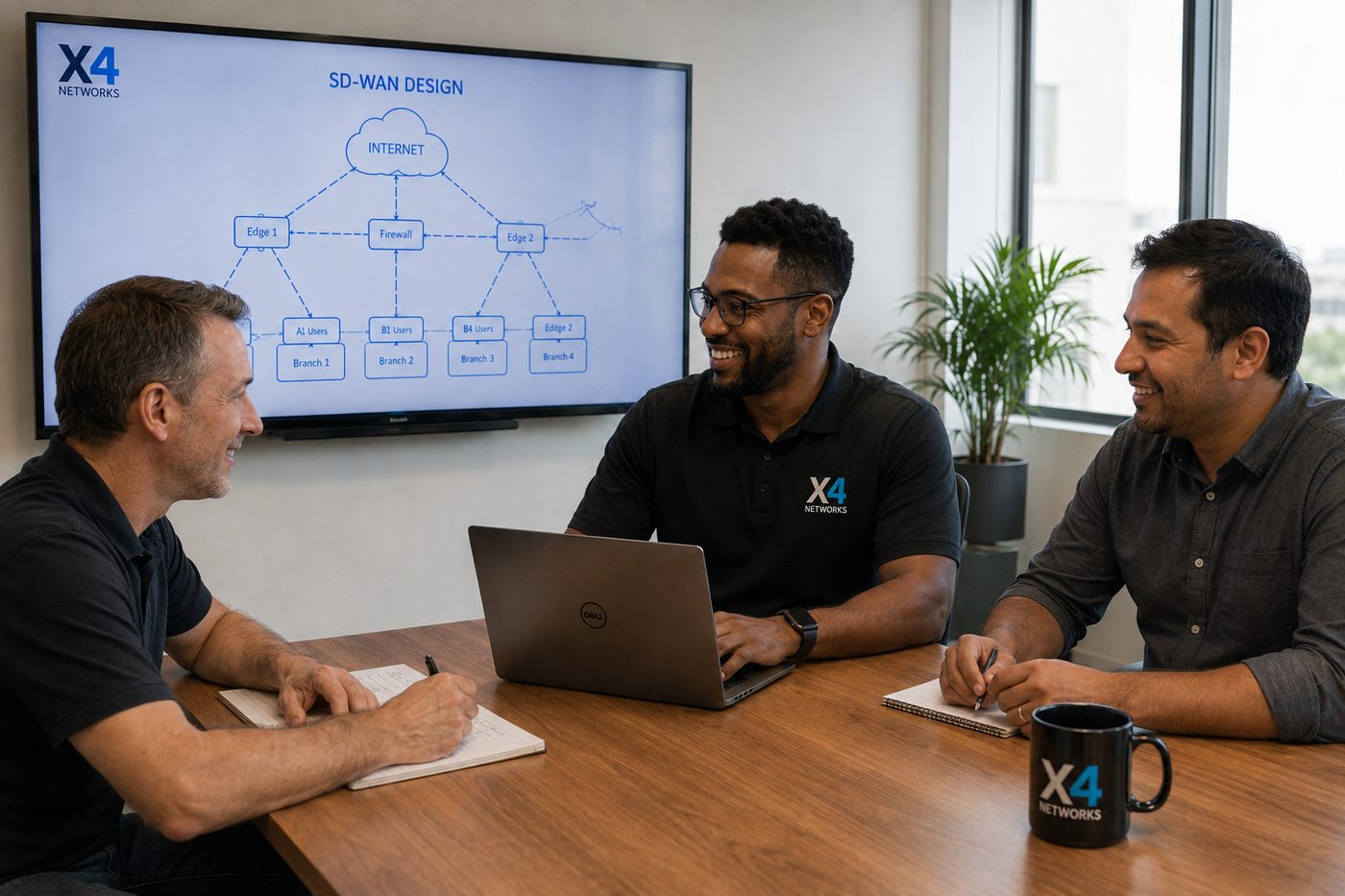
Your people move faster. Your applications stay available. And the network stops being the thing everyone worries about.
We do not send a polished design over the wall and disappear. We learn the environment with your team, make the choices together, and carry them through the rack, the console, and the change window.
Usually nothing is on fire. Something is simply slower, riskier, or harder to explain than it should be. We step in beside your team and close it.
We trace the traffic, isolate the constraint, and fix the actual bottleneck—not the loudest symptom.
Senior engineering capacity to carry the design through implementation and a clean handback.
We rebuild it from the live environment, layer by layer, until the picture matches the racks.
Policy reviewed with context, exposure closed, and every remaining rule made explainable.
Routing, switching, security, and cloud investigated as one system instead of four queues.
One senior engineer owns the thread, gathers the evidence, and keeps it moving to resolution.
Spine count follows port radix and aggregate bandwidth—not leaf count. This two-leaf example uses bundled uplinks to preserve 1:1 capacity in the healthy state.
InfiniBand and Spectrum-X engineered so every GPU spends its time computing—not waiting.
Discuss the work →Datacenter, campus and WAN designed as one system, with no mystery hops.
Discuss the work →Identity, segmentation and policy that protect the business without slowing it down.
Discuss the work →A clean, observable path between users, workloads, providers and the internet.
Discuss the work →It is three stories happening at once. We verify each one against the live environment—then make them readable by humans.
GPU performance is not only a server question. The network determines how quickly accelerators exchange data, how well the cluster handles a failed path, and whether expensive compute waits on communication.
Translate training and inference goals into bandwidth, oversubscription, topology, port, cable, and growth requirements.
Rail-optimized leaf-spine designs, lossless transport, adaptive routing, isolation boundaries, and out-of-band management.
Rack elevations, port maps, optics, cable plans, labeling, staging, and installation that remains understandable at full density.
Confirm link health, path balance, latency, congestion behavior, failover, and end-to-end RDMA performance before the first production job.
As-built documentation, monitoring, baselines, upgrade plans, escalation paths, and runbooks your infrastructure team can own.
Click through the views—or play the guided walkthrough—to see how an operations team moves from cluster health to topology, traffic, and a developing congestion event.
A useful network drawing answers the next question before someone has to ask it. We map the live environment from physical connections through switching, routing, security policy, and traffic flow.
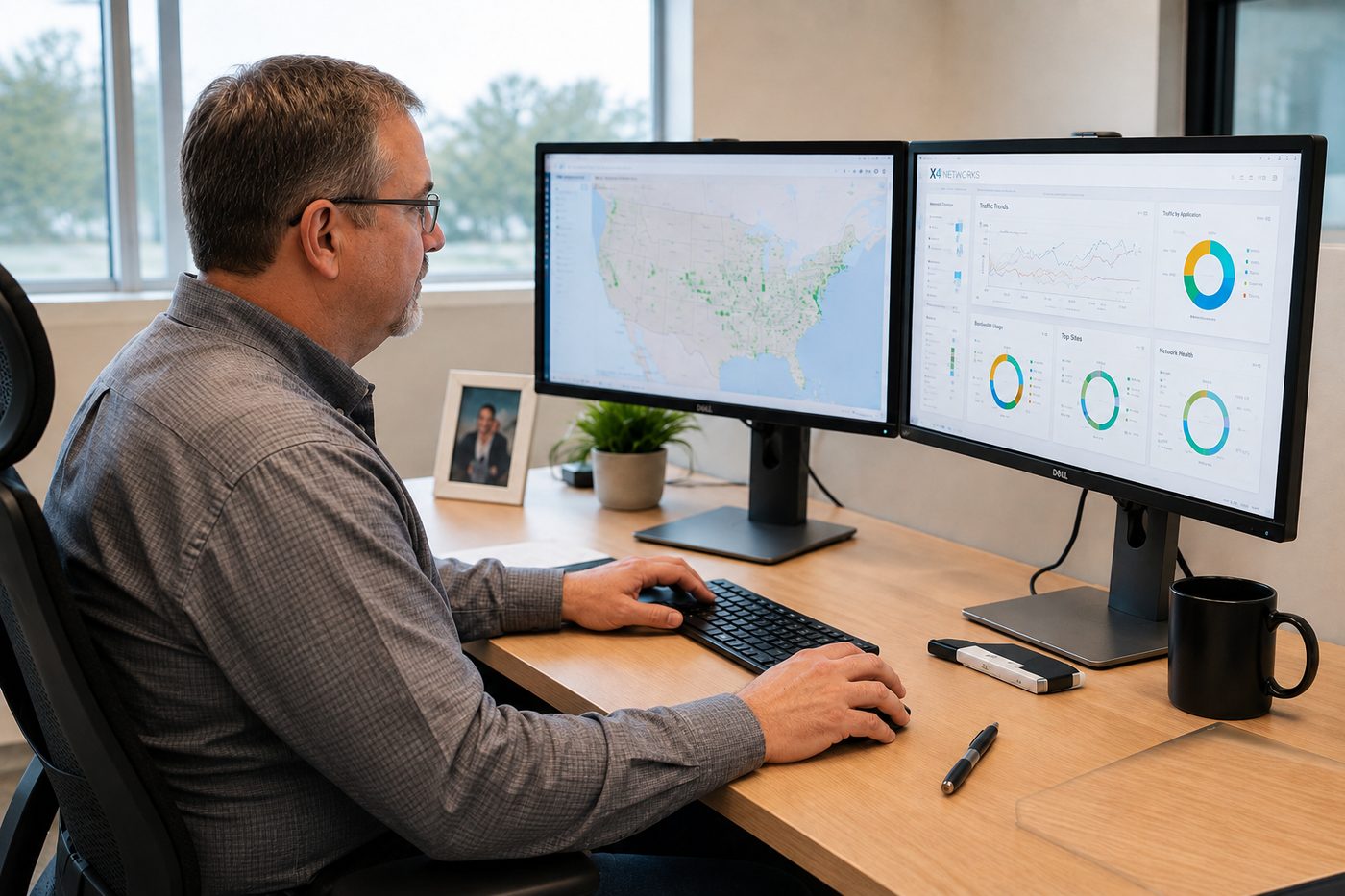
The hard problems rarely respect product boundaries. Our engineers work across the path so an issue does not disappear between specialties.
Identity-led access, useful segmentation, Palo Alto and Cisco firewall engineering, rule-base remediation, and ongoing support.
Talk through the exposure →Application-aware routing, predictable branch rollouts, cleaner operations, and honest visibility into how the fabric behaves.
Improve the fabric →Infrastructure, private connectivity, backup and replication, and policy carried consistently across providers.
Connect the environments →These reference cases expose the complete engineering chain: symptom, topology, counter evidence, design decision, implementation and acceptance result.
Training iterations developed a long tail while average link utilization still looked reasonable.
Normalized XmitWait concentrated on two host-facing ports; NCCL p99 aligned with the same windows.
Restore rail locality, move two HCAs to the correct leaf pair and enable the validated adaptive-routing profile.
Recable by rail, verify GUID-to-port mapping, run ibdiagnet, then repeat the collective acceptance suite.
Carrier maintenance produced an application-visible interruption despite dual circuits and dual cores.
Packet capture showed the data plane waiting on recursive next-hop repair after the physical loss.
Align BFD, routing timers and next-hop tracking with the application loss budget; remove hidden recursion.
Stage timers, fail each direction independently, capture loss bursts and document the rollback threshold.
GPU utilization collapsed during checkpoint writes; retransmits and pause duration rose together.
One optic showed symbol errors while PFC pause frames spread the symptom across otherwise healthy paths.
Replace the physical fault first, then validate ECN thresholds, PFC headroom and queue-to-priority mapping.
Swap cable, clear counters, replay storage load, prove no-drop behavior and record queue telemetry.
Trigger a modeled failure and watch the path, counters and CCIE investigation sequence change together.
Every artifact is paired with the question it answers. Official interface evidence is identified; lab captures are labeled; acceptance criteria stay visible.
 01 · Set the time window before correlating a counter spike.02 · Compare the affected port with its rail peers—not the fabric average.
| TEST | THRESHOLD | RESULT |
|---|---|---|
| Spine failover | < 2.0 s | 1.2 s · PASS |
| Collective p99 | < 25 ms | 19 ms · PASS |
| Normalized XmitWait | < 1.0% | 0.7% · PASS |
| Symbol errors | 0 / run | 0 · PASS |
| Rail imbalance | < 8% | 6% · WATCH |
UFM terminology is grounded in the NVIDIA UFM Enterprise telemetry documentation and the supported port-counter reference.
Four deliberate steps leave the environment more reliable—and your team better able to understand and operate it.
Walk the environment, pull live configuration, and listen to the people who run it every day.
Put the topology, risk, cost, and operational impact on the same page before a change begins.
Stage, implement, validate, and stay close through the change window and what comes after.
The same senior engineers remain reachable 24 × 7, without making your team start the story again.
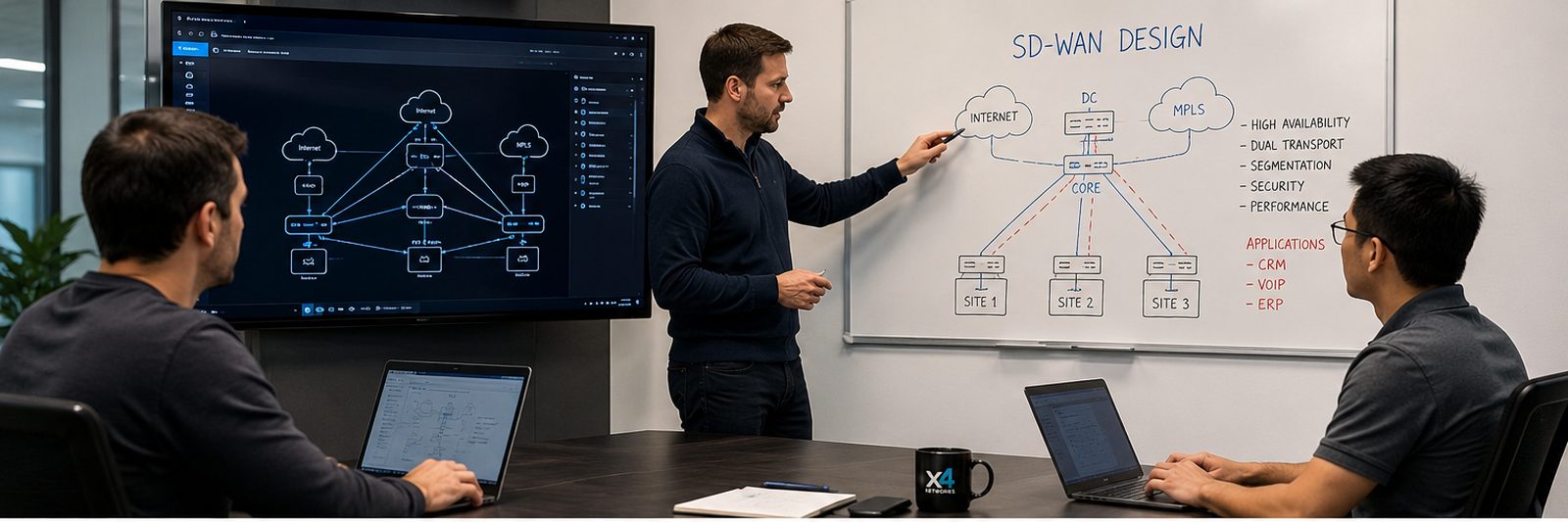
Our clients know the engineers by name. The person who learns the environment is the person who designs the change—and the person who picks up when something unexpected happens.
Your CCIE stays involved from the design review through the change window.
We document what is running—not what the old file says should be running.
We stay accountable after launch, with 24 × 7 access when the stakes are high.
Some clients need a full design and implementation. Others need one difficult project closed or a senior engineer who already knows the environment when the next issue appears.
Architecture, staging, implementation, validation, documentation, and operational handoff with one accountable team.
BEST FOR / AI FABRICS · DATACENTER · MAJOR REFRESHIndependent assessment, a clear recovery plan, and senior hands to move a delayed or high-risk project over the line.
BEST FOR / MIGRATIONS · POLICY CLEANUP · PERFORMANCEPlanned changes, escalation, upgrades, and 24 × 7 support from engineers who already understand the environment.
BEST FOR / LEAN TEAMS · COMPLEX NETWORKS · COVERAGEChoose a workload. The path, policy, and performance target change with it—because not every packet should be treated the same.
Large collective operations stay on the lossless fabric while adaptive routing balances congestion in real time.
Answer five quick questions. Nothing is saved or sent; the score stays in your browser.
Our diagrams match what is running now.
We can explain the owner and purpose of every firewall rule.
Branch, datacenter, and cloud are monitored as one environment.
A failed path has been tested—not just designed.
Our oldest open network project has a clear owner and next step.